Hong Kong McDonald's Hall
Hong Kong McDonald’s
McDonald’s is an American brand, founded in the 1940s–50s; by 2020 it was running fast-food restaurants in more than 100 countries. Yet “Hong Kong McDonald’s” arrived later than Café de Coral (大家樂) and Fairwood (大快活).
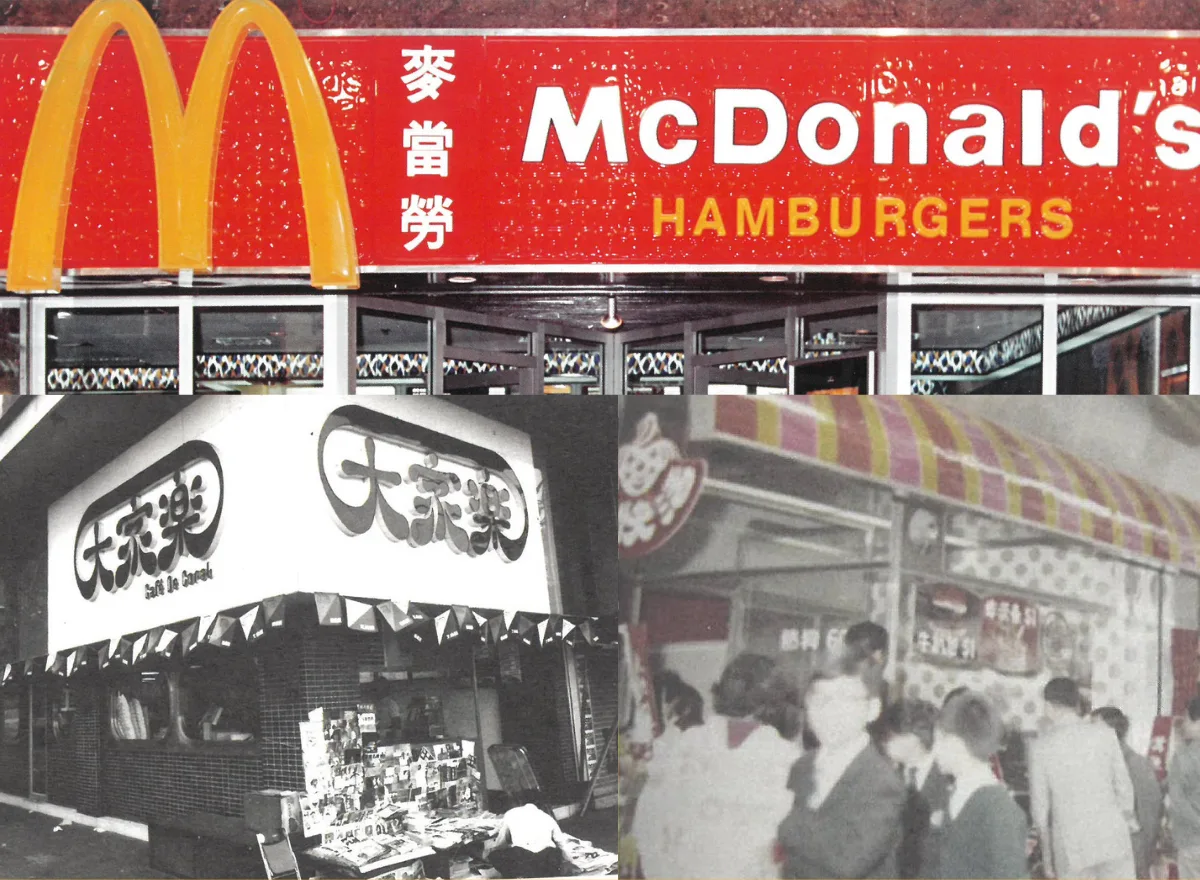
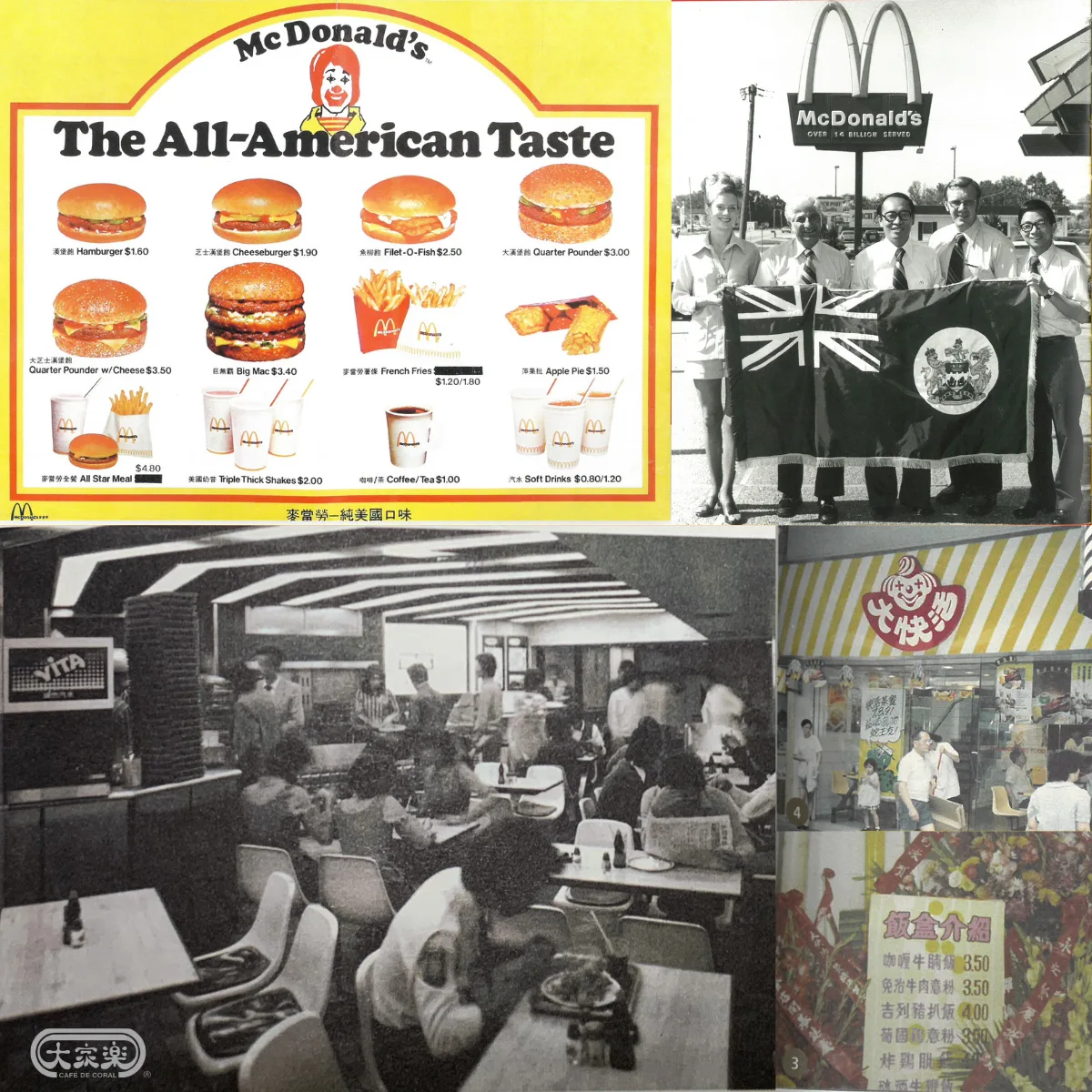
A year after the first McDonald’s outside the United States opened in Canada — that is, in 1969 — Café de Coral had already opened its first fast-food shop on Sugar Street in Causeway Bay, selling hamburgers at $0.35.
A year after McDonald’s opened its first Asian branch in Japan — that is, in 1972 — Fairwood opened on Chung On Street in Tsuen Wan, though its mainstay was dip tau faan (碟頭飯, one-plate rice dishes).
According to published accounts, the founder of Maxim’s was also running “Maxim’s fast food” in the late 1960s, though Maxim’s operated restaurants, coffee shops and bakeries at the same time. It has been said that the term “fast food” (快餐) was first adopted by the founder of Maxim’s.
Hong Kong McDonald’s did not open its first shop until 1975, on Paterson Street in Causeway Bay — but from then on, together with Café de Coral, it transformed the eating culture of Hong Kong people and became part of the collective memory of many of them.
Hong Kong’s own
McDonald’s
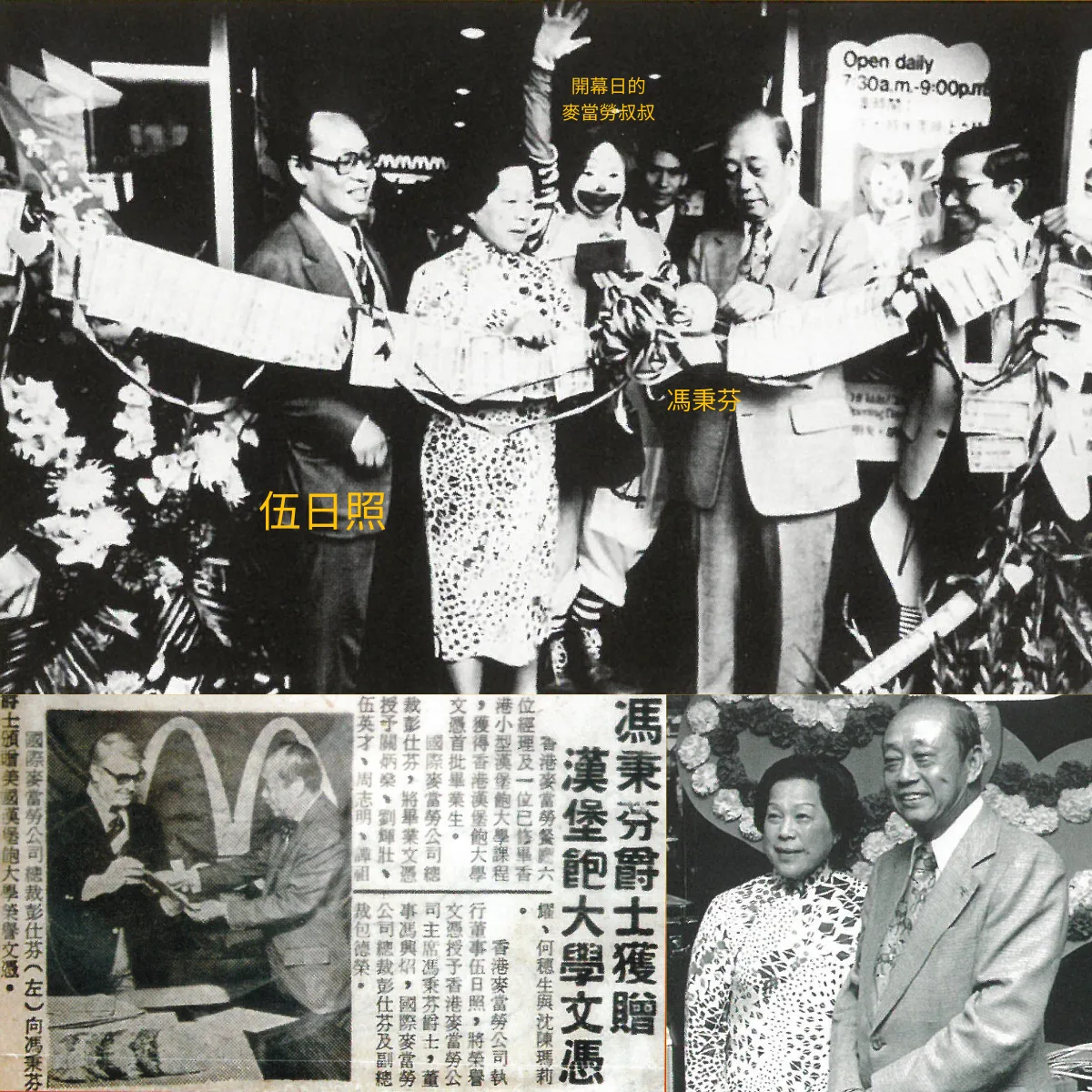
Although McDonald’s, unlike Café de Coral and Fairwood, was not founded in Hong Kong as either a company or a brand, it was a handful of Hong Kong people who opened the Hong Kong market for it — among them Daniel Ng Yat-chiu (伍日照), the Hong Kong businessman who conceived the Big Mac Index. The media dubbed him “the father of Hong Kong McDonald’s”, because it was he, together with his good friend Fung Hing-chiu (馮慶炤) — grandson of Fung Ping-shan, one of the founders of the Bank of East Asia — who obtained the Hong Kong franchise from the McDonald’s Corporation in the United States.
By coincidence, Lo Kwee-seong (羅桂祥) — elder brother of the two brothers who founded Café de Coral and Fairwood — also had a university-classmate friendship with the son of Kan Tong-po, another founder of the Bank of East Asia. Lo Kwee-seong was the founder of Vitasoy, which received help when it was starting out in the 1940s; even 80 years after opening, it remains close to the Bank of East Asia. (For the story of the Café de Coral and Fairwood founders and Vitasoy, see the Vitasoy Hall.) As for Fung Hing-chiu’s father, Kenneth Fung Ping-fan (馮秉芬), he was chairman of the Hong Kong McDonald’s company at the time.
Unlike the Café de Coral story, the founders of McDonald’s Hong Kong first trained with McDonald’s in the United States, bringing the proven American formula to Hong Kong. But they ran the business here hands-on, successfully carrying American fast-food culture into Hong Kong, and in branch numbers they came from behind to overtake Café de Coral and Fairwood.
In 1995 the American McDonald’s bought Hong Kong McDonald’s back from Daniel Ng and Fung Hing-chiu under their agreement — but in 2017 it sold 80% of the company operating McDonald’s in China and Hong Kong to CITIC Group and other mainland Chinese institutions. Reports later noted that the company’s name in China had been changed to 金拱門 (“Golden Arches”), setting off much discussion among Hong Kong people.
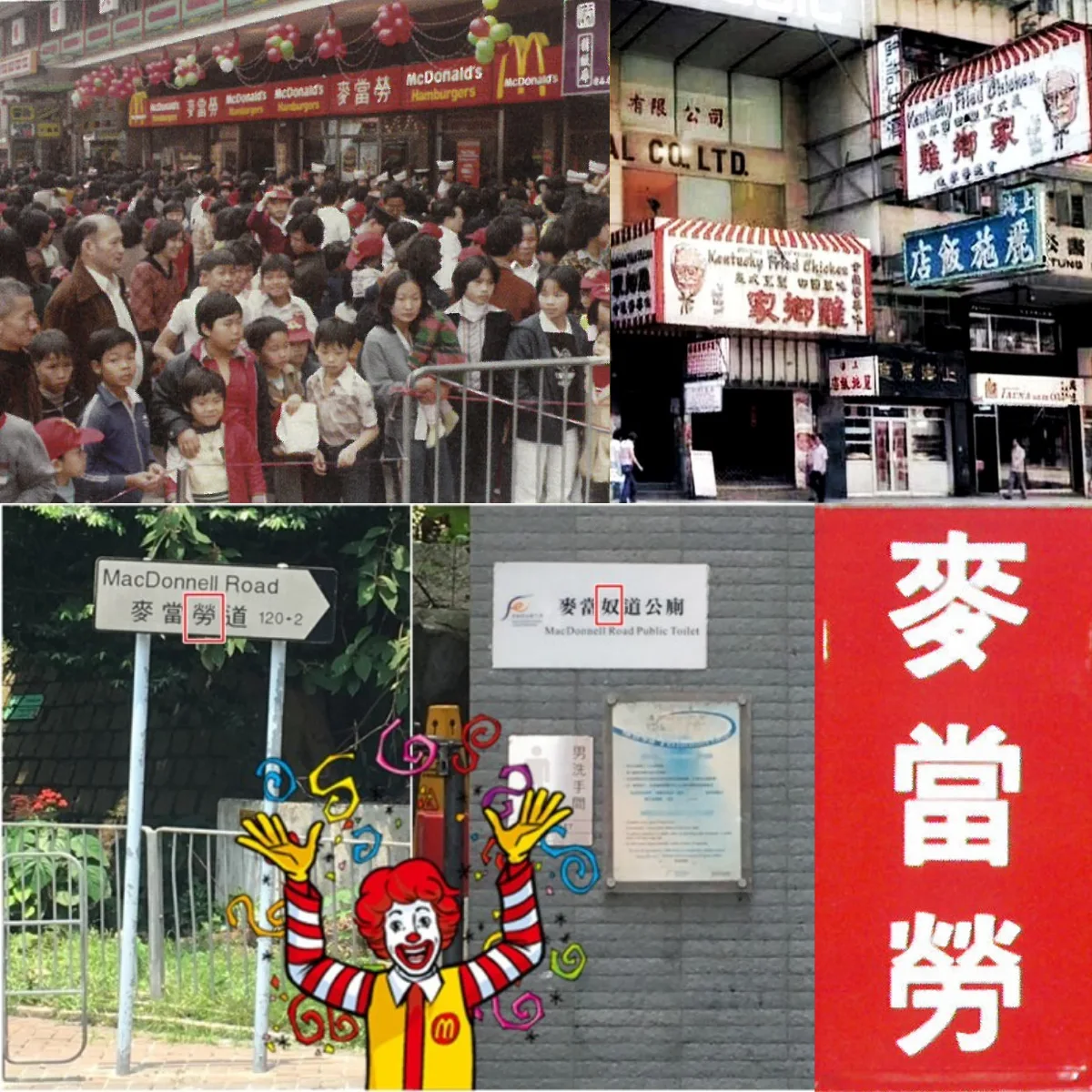
Mak Dong Nou (麥當奴)・
Mak Kei (麥記)・
Lou Mak (老麥)
Before the war, many foreign brands took on a down-to-earth Chinese name after arriving in Hong Kong — for example Swire, known as 太古, and Jardines, known as 怡和. By the 1970s, as Western culture came into fashion, this began to change.
Learning from the failure of KFC’s translated name 家鄉雞 (“hometown chicken”), McDonald’s took the Chinese name 麥當勞 (Mak Dong Lou), a ringing Cantonese transliteration full of foreign flavour. The Hong Kong McDonald’s that opened in 1975 then successfully carried this Hong Kong transliteration to Taiwan and mainland China, where the chain opened in 1984 and 1990 respectively. Daniel Ng noted that the McDonald’s in San Francisco’s Chinatown also uses the name 麥當勞. Read aloud in Mandarin, the three characters in fact sound quite unlike “McDonald’s”.
There is a MacDonnell Road (麥當勞道) in the Mid-Levels, but it has nothing to do with the fast-food brand: it is named in memory of Sir Richard Graves MacDonnell, Hong Kong’s sixth Governor. Before 1957 its Chinese name was written 麥當奴道, and since Hong Kong people have also rendered the English name Donald as 當奴, the spelling 麥當奴 sometimes appears. According to the writings of James L. Watson, a former visiting professor of anthropology at the Chinese University of Hong Kong, Hong Kong McDonald’s considered at its opening using the character 奴 to avoid confusion with MacDonnell Road.
Even as Hong Kong exported the name 麥當勞, locals began calling McDonald’s by nicknames — Mak Kei (麥記), Lou Mak (老麥), M Kei (M記) — and not only in everyday conversation: they turn up in news reports, films and interviews, and searching these terms on Google returns nothing but McDonald’s.
McDonald’s and Café de Coral: a fast-food pincer attack
The naming of 麥當勞 was meant to feel foreign — a name every Hong Kong person would understand to be a translation. Yet the rise of homegrown nicknames like Mak Kei and Lou Mak proved that Hong Kong McDonald’s had woven American fast-food eating culture into Hong Kong, and that Hong Kong people had broadly accepted it.
In Golden Arches East: McDonald’s in East Asia, James L. Watson, the retired Harvard professor, describes how McDonald’s broke through the Cantonese food culture in which Hong Kong people took such pride in the 1970s and 80s. In the 1960s and 70s Hong Kong was in a period of rapid economic growth, and the concept of “fast” had already merged fully into the daytime eating rhythm of Hong Kong people.
Yet Hong Kong people were then unfamiliar with American-style restaurants; even British-style thick-cut chips were not popular, and only Coca-Cola enjoyed wide appeal. McDonald’s also had to face the habit of the time of treating hamburgers, chips and sandwiches as snacks — McDonald’s was merely somewhere students would buy a bite on the way home from school, never a proper meal.
Café de Coral, by contrast, was extremely flexible at the time. A few years after opening, it borrowed from McDonald’s and KFC and redesigned its restaurants as self-service to increase customer flow; its menu kept the steadily selling hamburger alongside takeaway rice boxes, and it even copied the Mandarin hotel’s club sandwich (公司三文治) — a full display of the nimble, ever-changing Hong Kong style of fast food.
A Hongkonger’s brainchild:
the Big Mac Index
McDonald’s, for its part, worked to preserve the image of authentic foreign food. Beyond the conspicuously translated name, it initially advertised “pure American taste” and left even the menu untouched, building a perception completely different from local restaurants such as Café de Coral that also sold hamburgers — and catching the tide as Hong Kong people began to look up to European and American culture. McDonald’s trump card was price: once Hong Kong people had grown familiar with it in the late 1980s, its low prices penetrated the market powerfully and made it a proper-meal choice for the younger generation.
From the 1990s, McDonald’s became an eatery patronised by every stratum of Hong Kong society. The budget 超值選 (Chiu Jik Suen, “value picks”) menu still exists, and a McDonald’s price rise regularly makes the local news. McDonald’s seems to have taken on an obligation to provide cheap food options for the community’s lower-income groups — a positioning very different from McDonald’s outposts abroad.
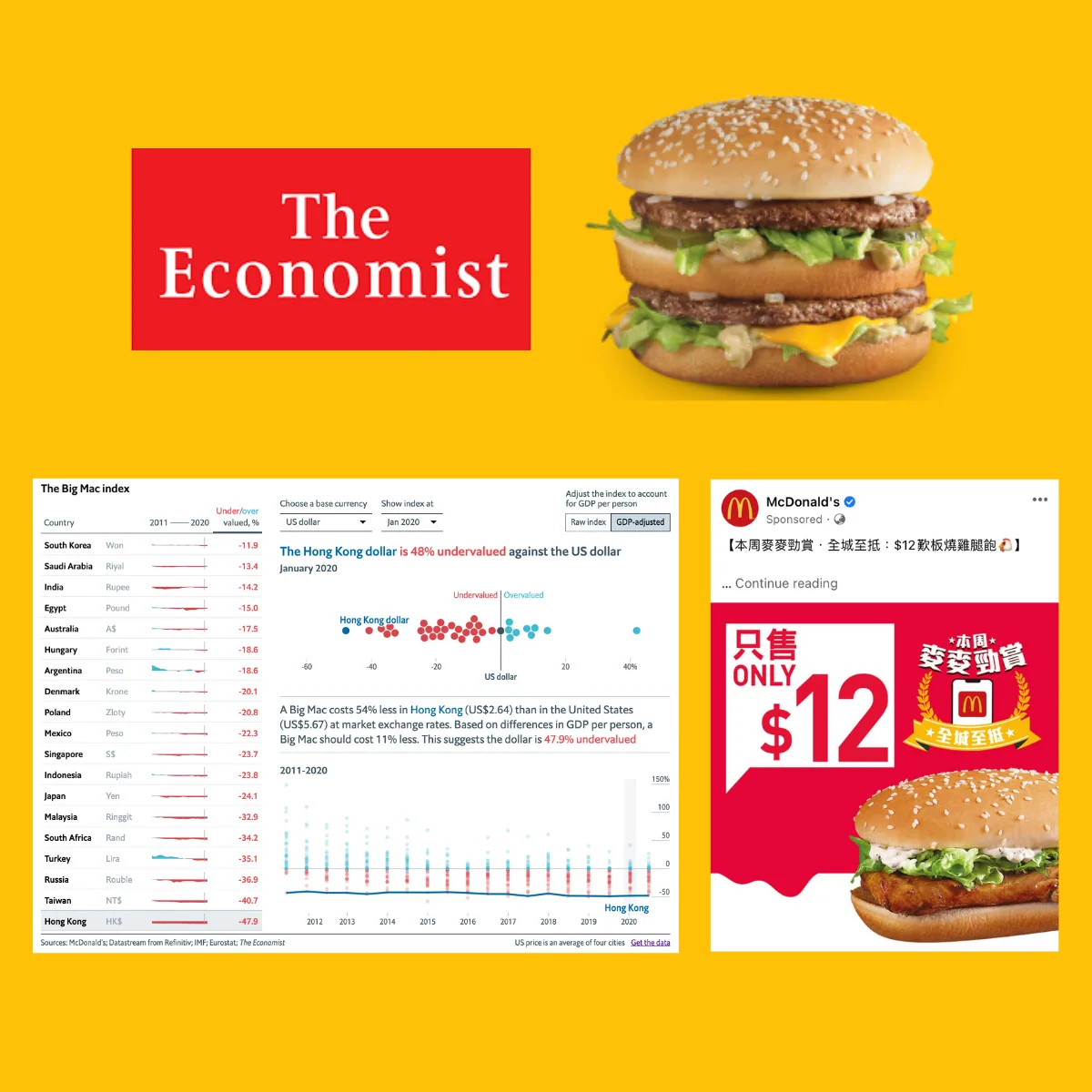
In 1986 the internationally renowned Economist launched the Big Mac Index, using the price of a McDonald’s Big Mac in different parts of the world to illustrate economic phenomena such as exchange rates and price differences. The index is widely cited in the media — and the idea for it came from Daniel Ng, founder of Hong Kong McDonald’s.
The price of a Big Mac in Hong Kong has long sat below the global average; taking the local economy into account, the GDP-adjusted index shows Hong Kong to be the cheapest place in the world for a Big Mac.
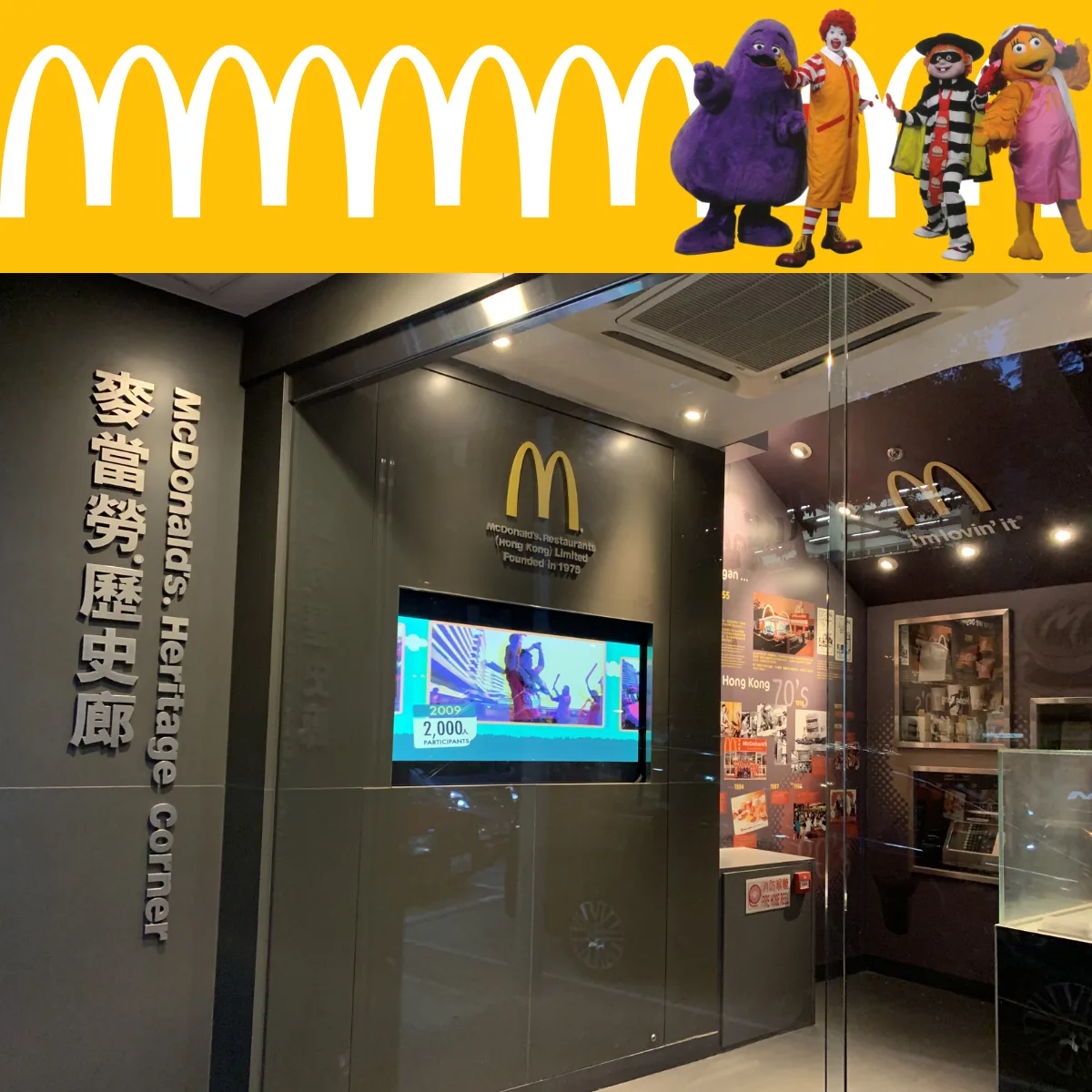
Hong Kong McDonald’s History Gallery
The McDonald’s in Shau Kei Wan houses a history gallery that is not often open, with simple display boards on McDonald’s history. The glass door is locked most of the time, but visitors can still look in from outside — though the text is rather hard to read.
Below the pictures is a 1975 McDonald’s television advertisement, from a time when customers still had to be taught that no tip was needed when eating at this “Western restaurant” called McDonald’s.
Those interested in McDonald’s history can also visit the McDonald’s website: https://www.mcdonalds.com.hk/ch/about-us/our-history.html
McDonald’s History Gallery
Address: G/F, Tung Fai Building (東輝大廈), 159 Shau Kei Wan Main Street East, Shau Kei Wan, Hong Kong Island
Opening hours: unknown
Sources:
愛・延續 : 麥當勞lovin’ 35年
作者:麥當勞有限公司
McDonald’s Restaurants (HK) Limited
初版 香港 : 明窗出版社 2010
您做足100分 : 大家樂集團四十年的蛻變與發展
蔡利民、江瓊珠著
香港 : 天地圖書有限公司 2008
金漆招牌
編著張宇人
香港 : 萬里機構・萬里書店 2015
香港商戰風雲錄
藍潮著
初版 香港 : 名流出版社 1997
香港走過的道路
劉潤和、高添強著
香港增訂版 香港 : 三聯書店香港有限公司 2013
創業垂統 : 華人家族企業發展特質與思考
鄭宏泰, 高皓著
香港第一版 香港 : 三聯書店香港有限公司 2016
一個名牌的誕生
蘇慧心, 陳藹欣
初版 香港 : 明窗出版社有限公司 2004
Golden Arches East : McDonald’s in East Asia, Second Edition
/James L. Watson
2nd ed Stanford, CA : Stanford University Press 2020
https://corporate.mcdonalds.com
https://www.mcdonalds.com.hk/ch/about-us/our-history.html
https://www.economist.com/news/2020/07/15/the-big-mac-index
https://www.nytimes.com/2014/05/16/business/coke-and-mcdonalds-working-hand-in-hand-since-1955.html
https://www.britannica.com/topic/McDonalds
https://www.nytimes.com/1995/04/13/business/mcdonald-s-china-plan.html
https://hk.on.cc/hk/bkn/cnt/news/20170804/bkn-20170804160414744-0804_00822_001.html