Star Ferry Hall
The Star Ferry Company
A ferry glides slowly across the waters of Victoria Harbour, waves slapping against the hull and throwing up layer upon layer of white spray. The boat is full of visitors’ laughter and chatter as the sea breeze brushes gently past your cheek and tousles your hair… Though its golden age has long since passed, the Star Ferry looks much as it always has. Carrying the local memories of generation after generation of Hong Kong people, the Star Ferry has for many years served as a vital cross-harbour link between Hong Kong Island and Kowloon, and was once named by National Geographic Traveler as one of its “fifty places of a lifetime” — an honour it thoroughly earned, and a measure of just how much it means to Hong Kong people.
The truest portrait
of Hong Kong’s changing history
A business opportunity spotted by a baker
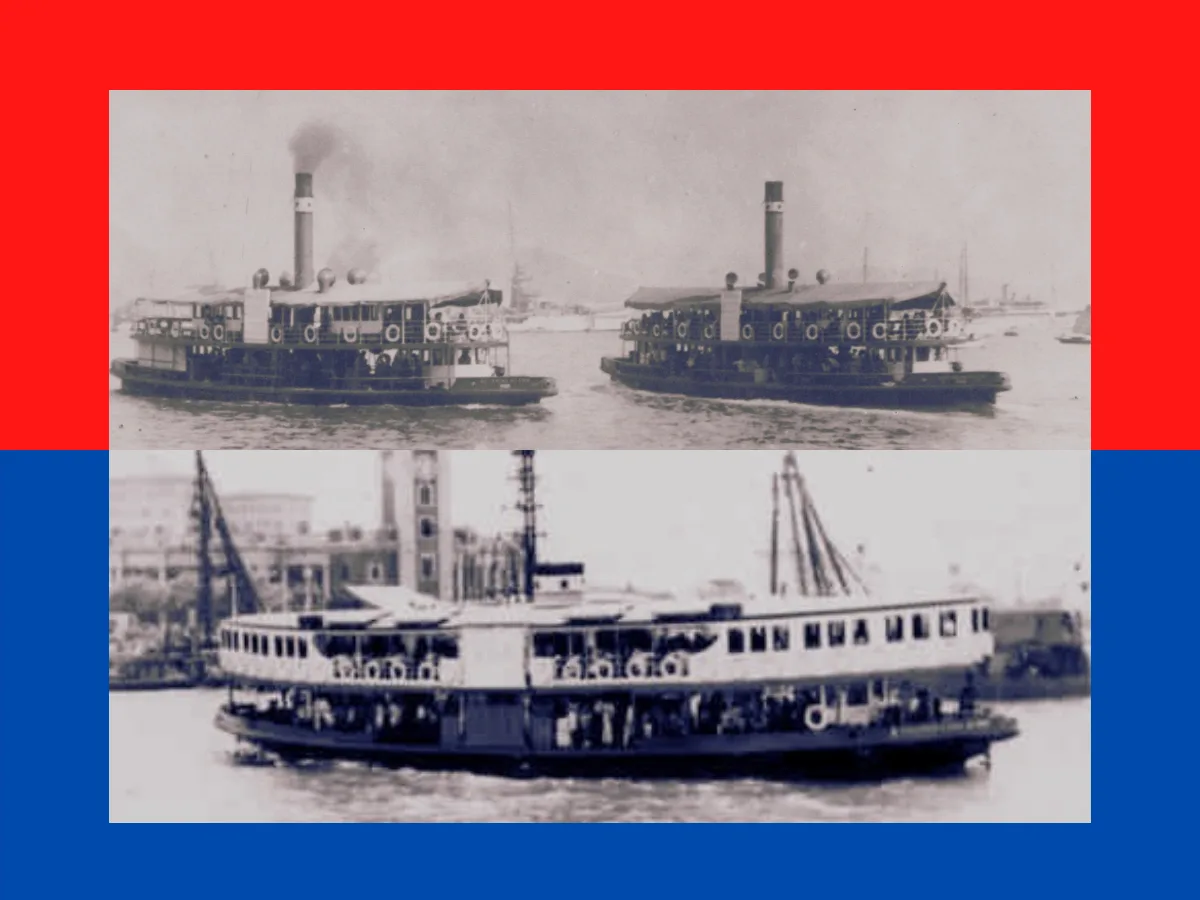
The history of the Star Ferry can be traced back to Hong Kong’s earliest colonial days. In 1880, a Parsee baker from Persia, Dorabjee Naorojee Mithaiwala, founded the Kowloon Ferry Company, using the steamboat Morning Star (曉星) to launch a ferry service between the two shores of Victoria Harbour. According to newspaper records of the time, the ferries departed every 40 minutes to an hour, running between Pedder Street in Central and Kowloon Point in Tsim Sha Tsui. A popular saying then held that the residents of Hong Kong Island and Kowloon “lived and died without ever meeting” — naturally, because transport was so undeveloped. The arrival of the cross-harbour ferry broke that isolation. Five coal-fired, single-deck boats set out on the voyage that would knit the two shores of the harbour together.
Over the following decade, Sir Paul Chater — an Armenian businessman with close ties to the government — and the Kowloon Wharf company he had co-founded bought up all the ferries, and in 1898 established the Star Ferry Company. The company took its name from the word “Star” carried by every vessel in its fleet. Before long, the ferries all gained an upper passenger deck, gradually approaching the fourth-generation ferry design we know today.
The Star Ferry:
First class, just to cross the harbour?
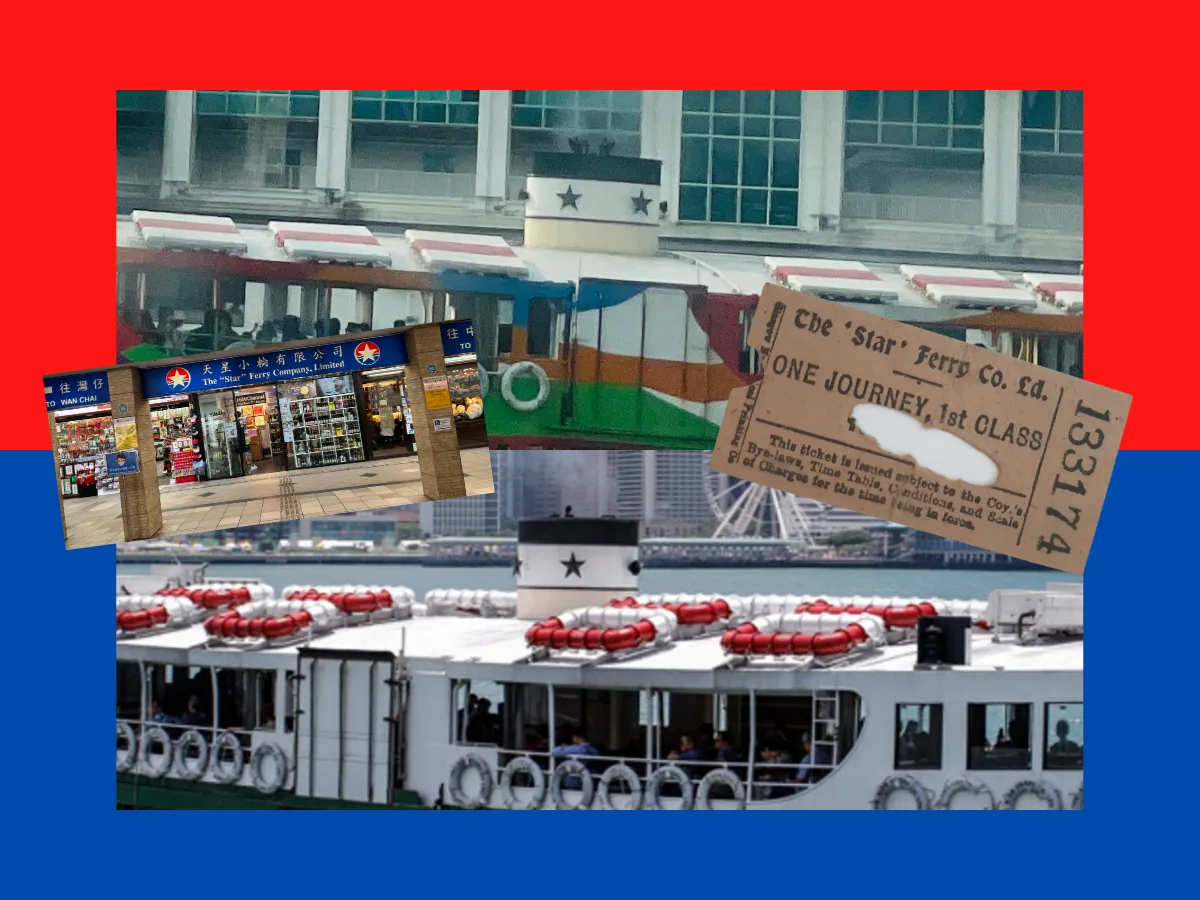
The Star Ferry fleet, now more than a century old, uses a traditional double-ended design, with hulls painted white and green. The iconic two-tone livery symbolises sky and sea — heaven above, ocean below. Sky and sea united, it also symbolises the Star Ferry as the link between the two, coexisting in harmony with the scenery on both shores and underlining its central role in Victoria Harbour. Four stars decorate the funnel on the roof of each boat; the funnel sections inside the cabins have been removed, and the exposed funnels now serve purely as decoration, preserving the traditional Star Ferry design.
Today’s Star Ferry no longer has separate classes, but in the early twentieth century, when class consciousness in Hong Kong was rigid, the Star Ferry divided its cabins by race. Chinese passengers could not ride first class; only foreigners could. After the Second World War, social attitudes shifted somewhat, and the dividing line became wealth rather than race. From then on, anyone with the money for a ticket and respectable clothes could ride first class.
The third-class cabin of those days had no seats. After work it would turn into something like a dai tat dei (大笪地, an open-air night bazaar): people drawing pictures, singing opera for coins, hawking goods, even selling beef offal. That old Hong Kong street atmosphere, that distinctive everyday flavour of ordinary life, is nowhere to be found on the ferries today.
The Star Ferry piers: a collective memory of Hong Kong people
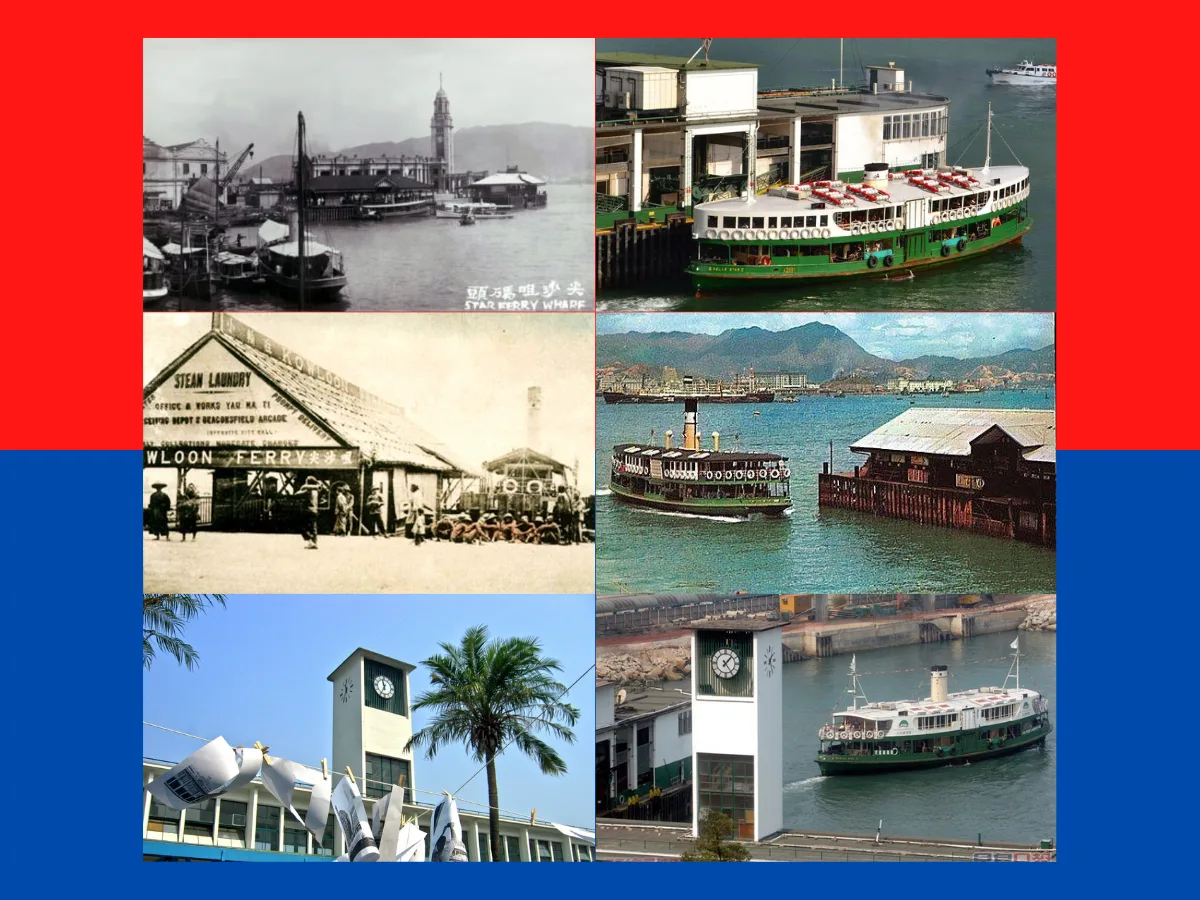
The Star Ferry’s golden route between Tsim Sha Tsui and Central seems to have run unchanged for over a century. In fact, the locations of the Star Ferry piers on both shores have shifted several times as the coastline itself has changed. The first Star Ferry pier in Central stood on Connaught Road Central near Ice House Street — roughly opposite today’s Jardine House, where the Connaught Road Central underpass now runs. That pier was nothing more than a crude structure of thatched grass.
In 1957 the Central Star Ferry pier moved to Edinburgh Place, next to the then Queen’s Pier, and remained there until the end of 2006, when it moved to today’s Central Pier No. 7. The Edinburgh Place pier operated for nearly 50 years, spanning many of the most important chapters of Hong Kong’s history, and became part of the collective memory of many Hong Kong people today.
For nearly half a century, the clock tower beside the pier rang out its familiar hourly chimes for the public, and together with the rickshaws waiting outside, the pier became one of Hong Kong’s tourist sights. The clock tower’s mechanical bronze bell, it turns out, came from the same maker as Big Ben in London.
The Tsim Sha Tsui Star Ferry pier has seen fewer changes than Central’s. In 1898, two days after Kowloon Wharf established the Star Ferry, it granted the ferry company exclusive use of the pier in front of the wharf’s main gate. In 1906 a newly built Star Ferry pier opened near the site of today’s Ocean Terminal, in the area then called Kowloon Point.
In 1910, the Star Ferry won the government auction for a pier site being sold off ahead of the opening of the Kowloon–Canton Railway terminus — the site of today’s Tsim Sha Tsui Star Ferry pier. It was rebuilt in 1957, at the same time as the new Edinburgh Place pier and to the same two-storey design, which survives to this day. When the Edinburgh Place pier was demolished, Hong Kong people still kept half of the memory on the opposite shore of the harbour.
Five cents that sparked
the “Dau Ling Disturbances”
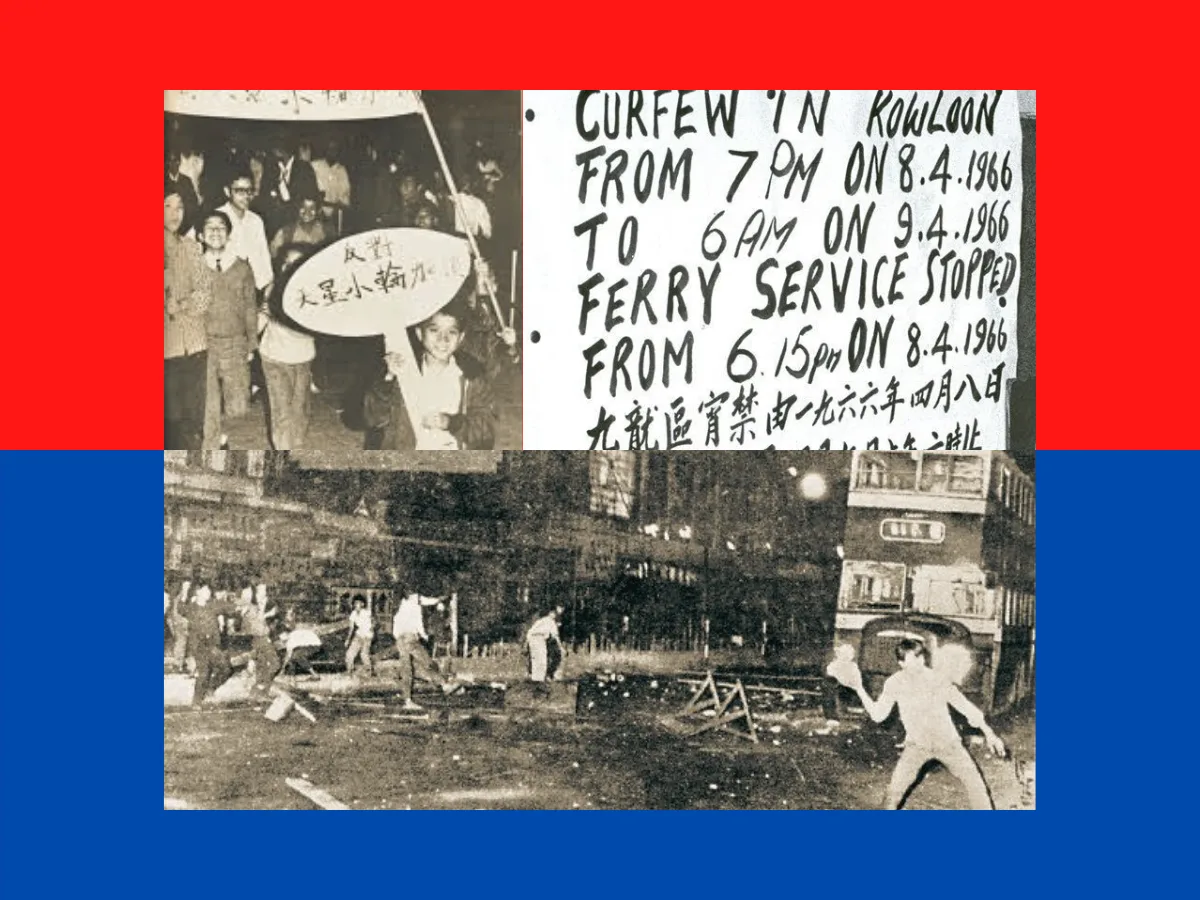
The Star Ferry has been more than a tourist attraction; it was once an essential part of Hong Kong daily life — and was consequently drawn into political turmoil. In April 1966, the Star Ferry triggered fierce public protest by raising its first-class fare from 20 cents by 5 cents. At the time, 5 cents was about a third of the price of breakfast, so the increase was steep and public reaction was intense.
A young man named So Sau-chung went on hunger strike in protest, and the affair escalated into unrest and rioting across Kowloon, at one point forcing the suspension of the ferry service at Hung Hom. The 5-cent coin was then nicknamed the “dau ling” (斗零), so the episode became popularly known as the “Dau Ling Disturbances” — the 1966 Star Ferry riots.
When the Cross-Harbour Tunnel opened in the 1970s, tunnel buses entered service and the cross-harbour MTR (the former Mass Transit Railway) began running. The cross-harbour ferry went from being the spark of a riot to a public transport service facing cutbacks. Confronted with falling passenger numbers, the Star Ferry Company had no choice but to reduce sailings to cut costs — creating a vicious circle, as the thinner timetable pushed passengers towards other modes of transport.
An island unto itself —
and a world-famous attraction
As the ferries fought for survival, the government offered little help in its town planning. Hong Kong’s core transport policy is “railway as the backbone,” so ferries had long ceased to be regarded as essential cross-harbour transport. In 2006, the government decided to move the Edinburgh Place pier to Central Pier No. 7, igniting the sensational “Save the Star Ferry Pier” movement — but the pier was demolished all the same.
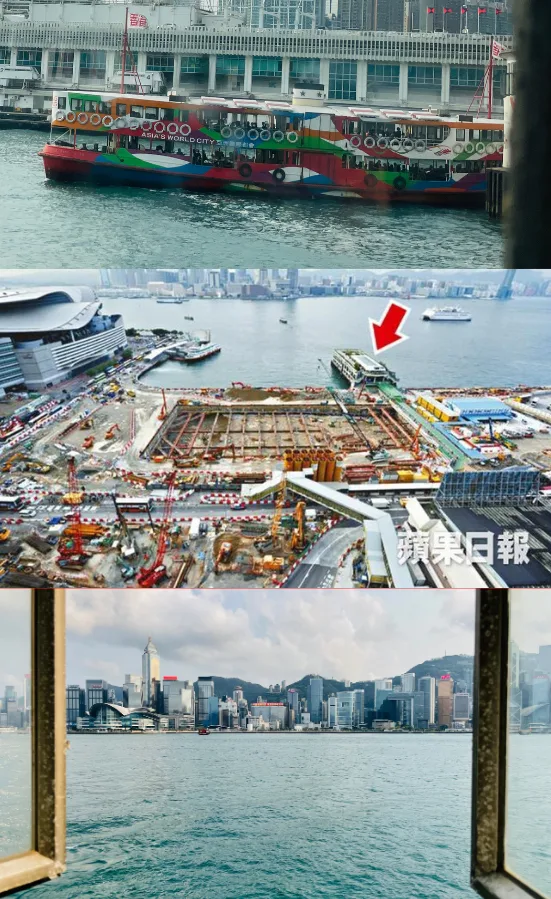
For over a century, the Star Ferry has never been able to escape pier relocations forced by land reclamation. In 2014 the Wan Chai pier was moved 150 metres seaward; after the move it was completely hemmed in by construction sites for the then-unfinished fourth cross-harbour rail tunnel, and combined with its already unfavourable new location, the pier remained like an isolated island until around 2020, losing passengers all the more easily.
The Star Ferry’s standing in public transport is a shadow of what it was. Yet even facing the reality of a shrinking ferry industry, the Star Ferry has accompanied Hong Kong people through a hundred years and has long since become a landmark symbolising the city. After Hong Kong’s return to China in 1997, the Star Ferry appeared in National Geographic Traveler and became an international-class tourist attraction, binding the intoxicating scenery of both shores of Victoria Harbour and the A Symphony of Lights show to this century-old cross-harbour ferry — perhaps this, too, is the truest portrait of Hong Kong’s changing history.
Sources:
香港歷史圖片 : 博物館藏品精選 (Historical Pictures of Hong Kong: Selected Museum Collections)
香港博物館編輯
香港歷史博物館
香港 : 香港市政局 1982
香港海上交通170年 (170 Years of Hong Kong Marine Transport)
陳志華
初版 香港 : 中華書局 2012
香港築印 (Hong Kong Architectural Imprints)
文, 馮俊鍵 ; 攝影、插圖, 陳耀慈
香港 : 非凡出版 2020年6月
香港舊事見聞錄 (Records of Old Hong Kong)
陳謙
初版 香港 : 中原出版社 1987
集體回憶之維多利亞港 : 百年海港的故事 (Collective Memories of Victoria Harbour: The Story of a Century-old Harbour)
何耀生
初版 香港 : 明報出版社 2005
上半山下中環 : 一個城區的蛻變 (Mid-Levels Above, Central Below: The Transformation of a District)
余震宇編著
初版 香港 : 中華書局香港有限公司 2017
九龍海岸線 = Coastline of the Kowloon Peninsula
余震宇編著
初版 香港 : 中華書局香港有限公司 c2015
香港電台電視部 - 香港故事 (第19輯) - 我們的品牌 (RTHK Television — Hong Kong Stories, Series 19: Our Brands)
https://www.nationalgeographic.com/travel/article/hong-kong-must-dos
http://www.thevoice.org.hk/thevoiceOnline/article.asp?Position=7&ToPage=1&Class=11
https://hk.appledaily.com/local/20160810/USZBVPYKRTDYCPU5T6NINKX47U/ [archived]
<../pdfs/starferry-9789629374211-preview.pdf>
http://news.bbc.co.uk/chinese/trad/hi/newsid_6140000/newsid_6140600/6140652.stm
Published in April 2021 by Hong Kong Brand Museum 香港品牌博物館