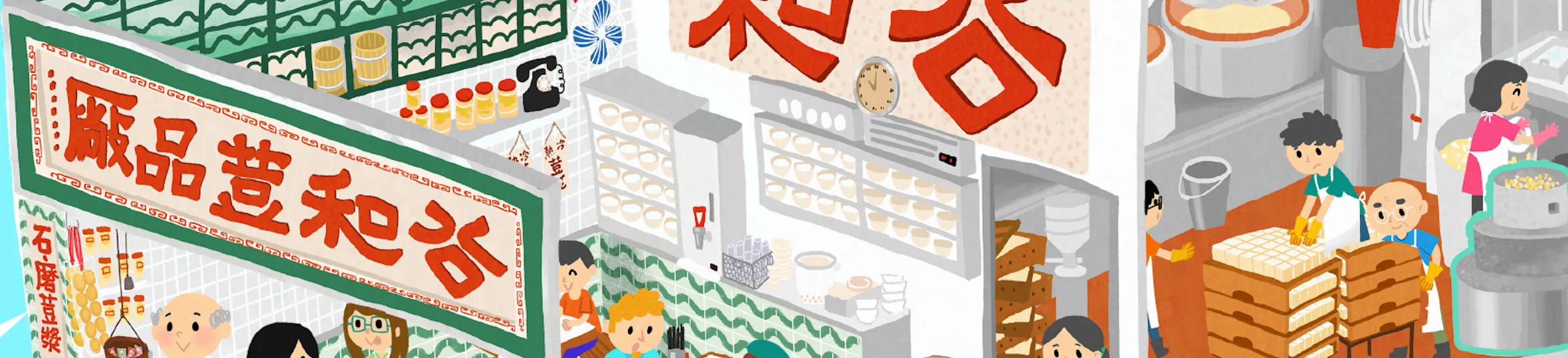
[Further Reading] The Birth of a Beancurd Factory: Kung Wo Beancurd Factory
The Birth of a Beancurd Factory | Further Reading
The brand story of Kung Wo Beancurd Factory (公和荳品廠) in Sham Shui Po:
“Passing on a legacy is not easy — it takes perseverance.”
“Sadly, in this generation many descendants are unwilling to take over traditional family-run old shops. We do our best to keep going, to preserve something distinctive and traditional for the next generation.”
Arriving at Kung Wo Beancurd Factory on Pei Ho Street, Sham Shui Po at half past ten in the morning, we admired the shop’s fittings while waiting for Renee, who runs it. Eating at Hong Kong’s traditional food shops, one rarely has the chance to savour the people, scenes and objects inside. When the fourth-generation successor, Renee So Yee-ha (蘇意霞), arrived, we listened over bowls of dau fu fa (豆腐花, silky tofu pudding) as she recounted how, since taking over the old shop about ten years ago, she has resolved all manner of challenges — along with some delightful brand stories.
Kung Wo was founded in 1893 by Lok Kung-wo (駱公和), making soya milk, tofu, dau fu fa and other soya products; in 1958 it moved from Canton Road in Yau Ma Tei to Pei Ho Street in Sham Shui Po. In 1997, when the second-generation descendants of the Lok family emigrated, the Poon family took over the Kowloon City branch and the So family took over the Sham Shui Po shop. So Sung-lim (蘇崇廉) inherited the Lok family’s recipes and kept refining them through his own study, and over these twenty-odd years Kung Wo’s craft of making traditional soya products has been passed on.
Defusing the crises of running an old shop
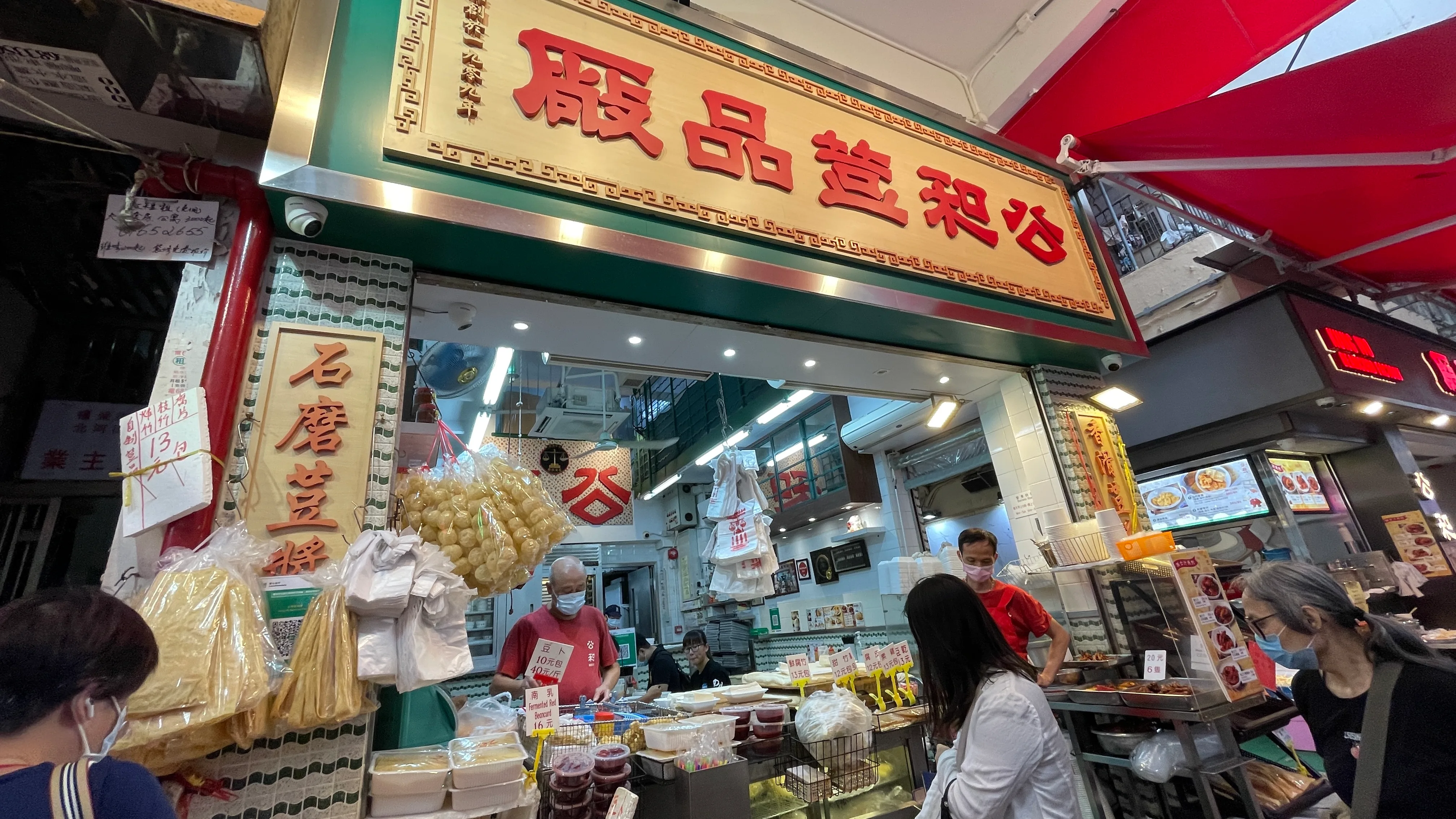
The Kung Wo we see today — shop in front, workshop behind — kept the feel of a traditional shopfront through a major renovation in 2016 while also resolving a crisis in its operations. Over HK$1 million was spent that year refurbishing the shop and applying for a restaurant licence. Renee describes the whole process as “treading on thin ice at every step”: renovating an old shop is even harder than designing a new one, because conservation has to be weighed throughout.
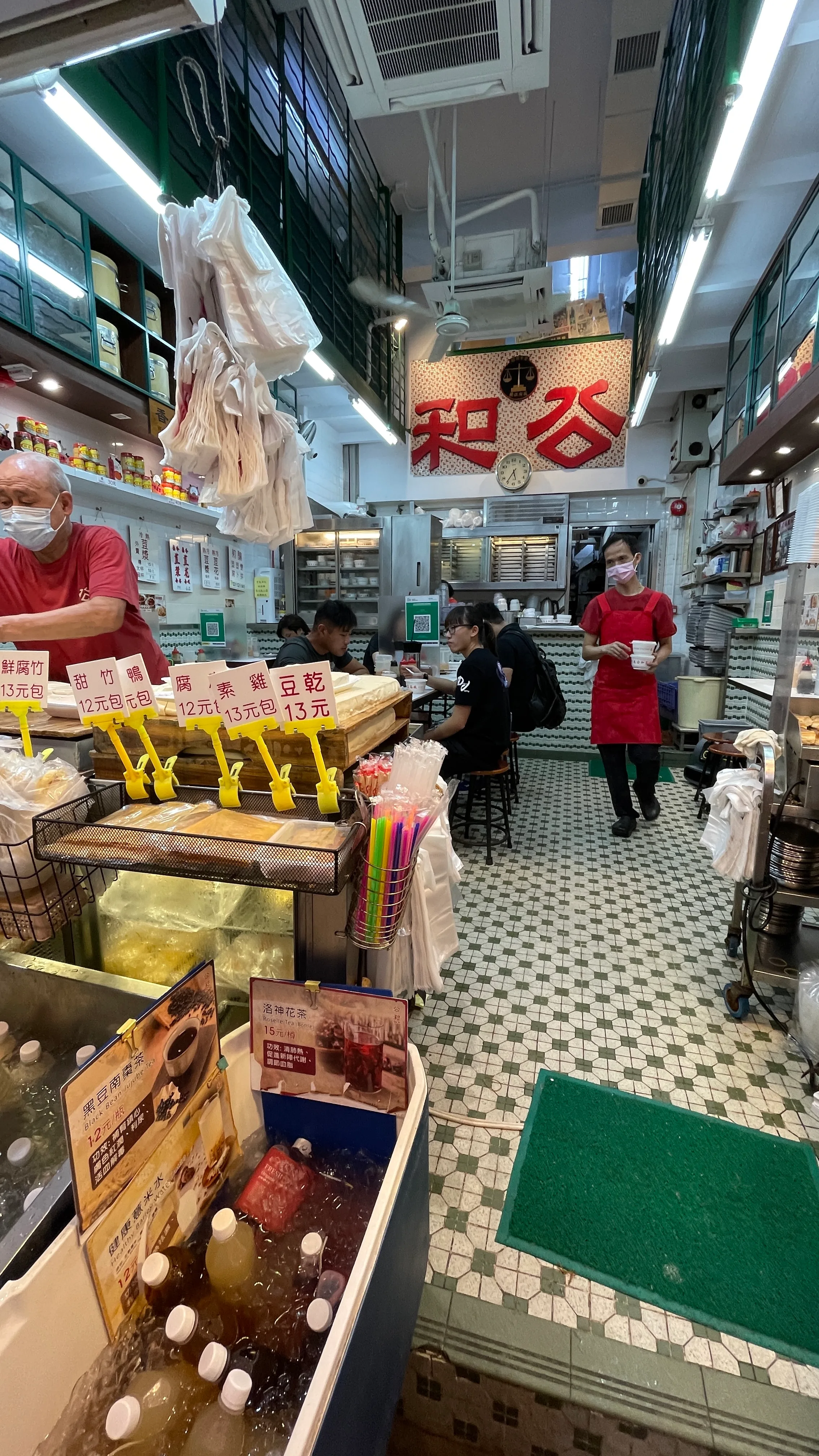
The shop is bright and spotless, the staff busy, and dine-in customers arrive in a steady stream. Tofu, dau fu fa, soya milk and tofu puffs go out non-stop, takeaway and dine-in alike. Sweet beancurd sticks, fresh beancurd sticks and tofu skin are laid out neatly, with signs in both Chinese and English for the convenience of customers of different nationalities. The menus, too, are bilingual. After we had sat for a while, someone at a table behind asked me in English to pass the menu over; from their conversation, they were clearly tourists.
Today we decided to be not diners but tourists for a day, so that everyone can hear this brand story from a branding point of view.
-
The birth of the signboard: Kung Wo’s signboard was in fact inscribed by the famous calligrapher Au Kin-kung (區建公) in archaic Northern Wei regular script — forceful and bold, the perfect style for a shop sign. Many old shops had such inscriptions made into wooden signboards, a common sight in Hong Kong from the post-war 1940s onwards. These Hong Kong signboards favoured bright lettering and colours — red or green characters on a white ground were extremely popular — everyone, of course, competing for the eye among the crowd of shops. The old signboard of the well-known Kee Wah Bakery is also Au Kin-kung’s work. Renee says that during the renovation a few years ago someone offered a high price for Kung Wo’s wooden signboard, but weighing its heritage value, the family in the end donated the shopfront and signboard together to the Hong Kong Museum of History for its collection.
-
The renovation: Kung Wo originally held only a food-factory licence and could not serve customers on the premises. To obtain a restaurant licence, over HK$1 million was spent in 2016 refurbishing the shop — preserving the imprint of history while also keeping the decor in step with the times. Not being a big brand, they engaged no brand consultant; that customers have loved Kung Wo all these years came about, as she puts it, quite unplanned. The old shop originally stood on Canton Road in Tsim Sha Tsui and, after redevelopment, moved in 1958 to Pei Ho Street in Sham Shui Po. Like many Hong Kong old shops of the 1960s, the earlier decor ran chiefly to green, yellow and red: pink ceramic tiles with green geometric mosaic tesserae (紙皮石) made up the most typical look of the day. Printing the brand name on the crockery, it turns out, was a special idea of Renee’s father many years ago. To cope with takeaway demand they once switched entirely to plastic bowls for dau fu fa, but customers said they preferred the white porcelain bowls printed with the brand’s characters — so those have been kept to this day.
-
The old-shop experience: the shop’s new design keeps as much of the original signboard’s design as possible, with bricks and tiles in matching colours and patterns. Although air-conditioning has been installed in a semi-open layout, the old ceiling fans and the cockloft remain, and as much of the old mosaic-tile flooring and furniture as possible has been retained. The rotary-dial telephone — a “founding treasure” — and an abacus some fifty or sixty years old have become display pieces, while the bamboo basket used for collecting payment still hangs in the most eye-catching spot in the shop. The roughly 300-square-foot cockloft upstairs holds the shop’s precious memories: in the 1970s, when public housing was in short supply, it served at its peak as a “dormitory” for ten employees — at first there were no beds and they simply slept on the floor, until bunk beds (碌架床, luk ka chong) were added later.
-
Brand personality: what keeps customers’ affection and trust in Hong Kong’s traditional old shops is not product quality alone, but a personality all the brand’s own. The human warmth Kung Wo preserves is something even big brands with large promotion budgets can hardly achieve. Renee recalls the many difficulties encountered during the renovation, happily eased by the help and advice of several time-honoured firms, which saw those challenges through. Take the copper wok for boiling soya milk: raw-steel or stainless-steel woks scorch and stick easily, and in the end a fellow tradesman introduced an old coppersmith’s shop in Yau Ma Tei, where the master craftsman, in his eighties, agreed to fire the wok himself before a price had even been discussed. That older generation’s spirit of looking out for one another is precisely the rare capital — the brand value — of an old brand.
-
Brand recognition: many brands treat awards and quality certifications as corporate honours that help raise their profile, and for a restaurant, winning a recommendation — or even a star — in the Michelin Guide (米芝蓮指南), the Oscars of the food world, spurs many restaurants and chefs to improve. Yet Kung Wo, where the food is as good as it is inexpensive, has said that being listed or not is not what matters; what matters most is the quality of the food and the diners’ verdict. Becoming a Michelin-recommended eatery naturally brings more tourists and local diners, but holding to its positioning — championing the everyday, local food of the Sham Shui Po district — is the true path to success in sustainable marketing.
An old shop must pass on not only its precious product recipes, but also the core values of its brand. Hearing Renee tell of the many challenges Kung Wo has faced in recent years, we understood that beyond holding firm to and preserving what matters most in a brand, one must also move with the times — only then can these traditional trades truly be safeguarded.
Sources: interview with Kung Wo Beancurd Factory (edited in 2022) and assorted press reports
http://www.mingpaocanada.com/van/htm/News/20180118/HK-gfl1_er_r.htm [archived]
https://www.metropop.com.hk/-%E6%8A%AC%E9%A0%AD%E6%8B%9B%E7%89%8C%E6%9B%B8%E6%B3%95%E5%AD%97%E6%95%91%E4%BA%A1 [archived]
Last updated: November 2022. The further-reading links above supplement the material in the Hong Kong Brand Museum’s parent-and-child picture book 《豆品的故事》 (The Story of Soya Products). Every effort has been made in producing the book to ensure the accuracy and completeness of its contents; should any information be missing or in need of updating, please kindly let the authors know.